

From EMDR Client to EMDR Therapist: The Journey That Led Me Here
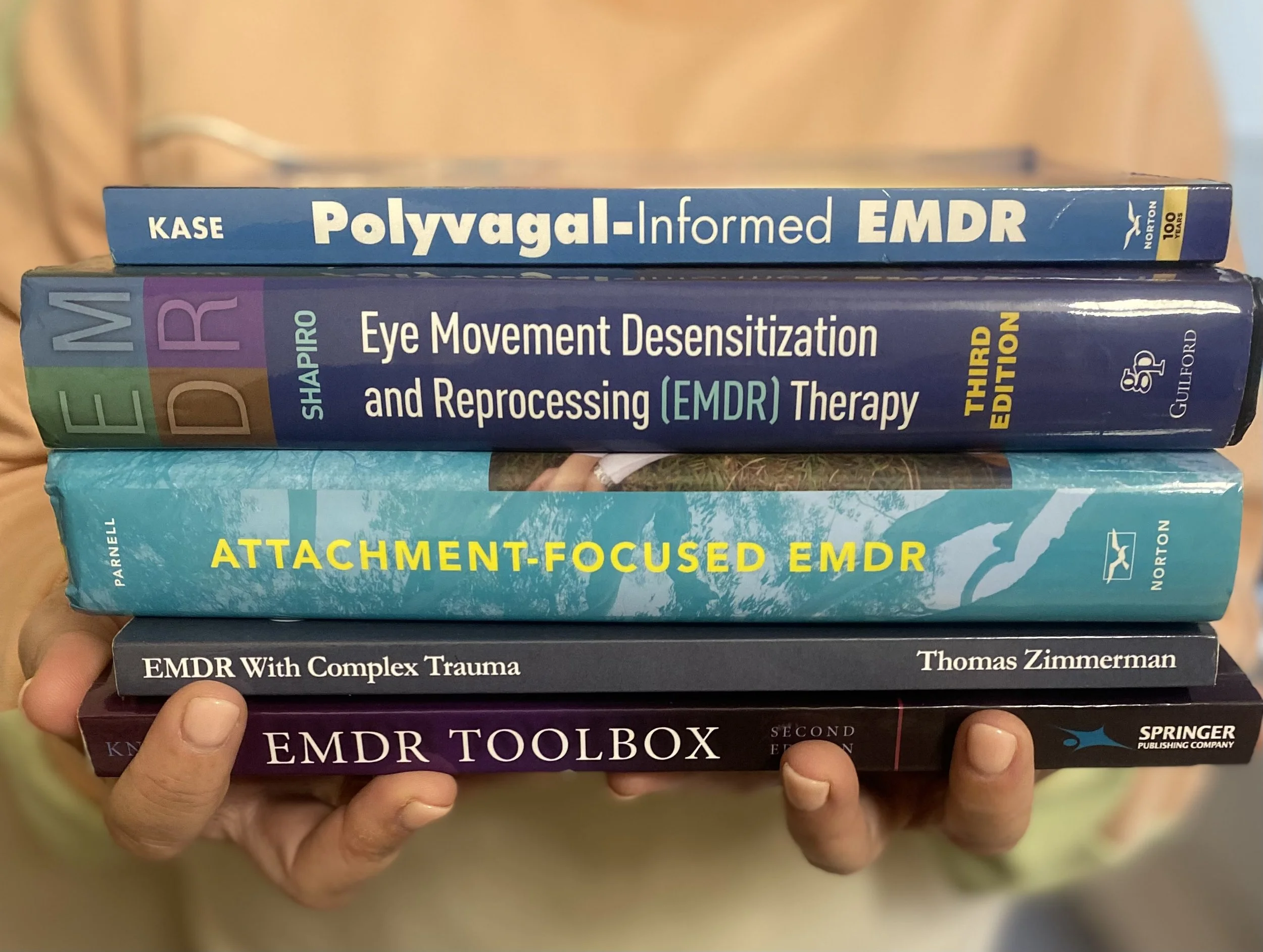
Before I ever trained in EMDR, I experienced it as a client, as a person who needed some help.
Before I ever trained in EMDR, I experienced it as a client, as a person who needed some help.
I was a brand new counsellor in training. I was learning about the world of therapy and still had so much to discover. EMDR wasn't on my radar, I hadn't heard of it, didn't understand how it worked, and definitely didn't imagine that one day it would become such a significant part of my own work.
I wasn't sitting in that psychologist's room as a counselling student, I was sitting there as a person who needed support. I was a completely burnt-out, anxiety-riddled, physically depleted mum of two young children.
On the outside, I was doing all the things. Looking after everyone else. Keeping life moving. Trying my best. On the inside, I was exhausted.
I remember being handed a sheet of paper with a list of negative beliefs. As I read through them, one seemed to jump off the page and hit me like a slap in the face.
"I am not good enough."
No surprise there.
That belief felt painfully familiar.
What I didn't have conscious awareness of was how far back that belief went, and how unresolved experiences from my past were still impacting me years later.
Through EMDR, I began to understand that this belief of not being good enough, hadn't started in adulthood or when I became a mum. It traced back to experiences in high school. Things I thought I had moved on from. Things I hadn't connected to the anxiety, self-doubt, perfectionism and pressure I was carrying years later.
That was the moment something shifted for me.
The best way I was able to describe my EMDR experience back then (before having the knowledge I do now) was this:
Before therapy, those memories felt like they were front and centre in my mind. They were easily triggered, emotionally charged, and seemed to influence so much of how I moved through life.
After EMDR, the memories didn't disappear. They simply moved. They felt like they had shifted somewhere off to the side. I could still access them if I needed to. I could remember what happened. But they no longer carried the same emotional distress or felt like they were controlling my present. The memories were still part of my story. They just weren't running the show anymore.
At the time, I was studying my counselling degree, and I remember walking out of that appointment thinking:
"I have no idea how this EMDR finger-waggling business works... but one day I want to learn how to do it."
There was just one catch.
To train in EMDR, I first had to become eligible. That meant completing my counselling degree, gaining clinical experience, and becoming a clinically registered counsellor.
The journey to get there wasn't a straight line.
After two previous attempts at university, I finally graduated at the age of 36. I still remember wearing the gown, throwing my cap in the air and feeling incredibly proud of what I had achieved. Just days later, the world shut down.
COVID arrived.
Our gym, our family business, not just somewhere I liked to train, was forcibly closed. Suddenly we were navigating the uncertainty of losing our business, homeschooling our children, and trying to make sense of a world that felt completely out of control.
Not surprisingly, my anxiety resurfaced. That familiar feeling of powerlessness returned.
So I found myself back in the same psychologist's room for more EMDR. This time, the focus was on feeling like I had no control, no choices, and a deep sense of helplessness.
Again, I was surprised by how intense these feelings were. As we worked through them, I began to recognise something familiar. They took me back to a time a few years earlier when I was living with chronic and debilitating back pain. I couldn't work, socialise, or even function. I couldn't properly care for my kids. I was taking heavy medication, and there wasn't much I could do except wait, wait for surgery, and then face the surgery itself.
At the time, I had simply got on with it. I hadn't realised how deeply those experiences of having no control, no choices and no way to change what was happening had stayed with me.
Once again, I experienced the difference EMDR could make. It created some space between what had happened in the past with my spinal injury and the intensity of what I was feeling in the present. That space gave me the opportunity to understand what was happening for me now, rather than being completely overwhelmed by the feelings, and to soften around them.
It reminded me that healing doesn't mean life will never be difficult again. It means that when difficult seasons arrive, you don't have to carry all the weight of what came before.
Fast forward to 2023.
I had finally become a clinically registered counsellor and was eligible to complete my EMDR Basic Training. So I took myself off to Tweed Heads twice in the space of a year to complete the six days of intensive EMDR Basic Training. Partly because it was an excellent training provider, and partly because if I was going to spend money on accommodation, I certainly wasn't spending it on a Sydney airport hotel! It was a big commitment, six days of training away from home, followed by another year of learning, supervision, practice, and working towards becoming an Accredited EMDR Practitioner.
It felt like a full-circle moment. Years earlier, I had been sitting in a psychologist's office as the client, wondering how this strange "finger-waggling business" could make such a profound difference.
Now I was learning how to offer that same experience to others.
Today, I feel incredibly privileged to sit alongside people as they work through experiences they may have carried for years.
But I never forget what it feels like to sit on the other side of the room.
I know what it feels like to be exhausted from holding everything together.
I know what it feels like to understand something logically, but still feel stuck emotionally.
I know what it feels like to wonder if things can actually feel different.
My experience with EMDR didn't erase my past. It changed the way those experiences lived inside me.
And that is the gift I now get to share with others. Because before I became an EMDR therapist, I was a client. I was a person who needed a hand. And I will never forget what it felt like to receive one.
Kate x
